
Access the master All-India Bhulekh & Bhu Naksha Portal to inspect verified Record of Rights (Khatauni, Jamabandi, Satbara, Khatian) and download village Bhu Naksha plot maps across all 36 States and Union Territories.
Family Land Share Calculator: Joint Khata Hissa & Inheritance Division Tool
Divide joint ancestral holdings among legal heirs according to the Hindu Succession Act. Enter the total land area from your computerized Khatauni or 7/12 extract, then select an equal split among heirs or enter custom fractional shares (such as 1/3, 1/6, or 2/5) to calculate each co-owner's legal share in Square Feet, Bighas, and Acres.
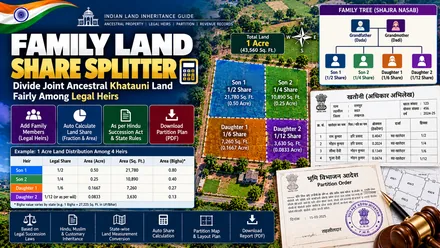
How to Use the Family Land Share Calculator
Enter total area recorded in Column 5 of your computerized Khatauni / Jamabandi.
Choose Hectare, Acre, Pucca Bigha, Bengal Bigha, Guntha, or Decimal.
Pick Equal Heirs or Custom Fractional Share (e.g. 1/3, 1/6, 2/5).
Check individual share in Square Feet, Meters, Bighas, Acres, and %.
Calculate Co-Sharer Hissa in Joint Khatauni Property
Enter total joint holding area and choose division mode:
Legal Framework: How Joint Ancestral Land is Divided in India
Dividing co-owned agricultural land involves distinct legal stages under the Hindu Succession Act, 1956 and state land revenue codes:
- Mutual Family Settlement (Khandani Batwara / पारिवारिक समझौता): If all co-sharers agree amicably on physical boundary boundaries, they can draft a mutual partition deed. In many states (like UP and MP), this can be submitted to the Revenue Tehsildar with minimal stamp duty for immediate mutation into separate individual Khatas.
- Revenue Partition Suit (बंटवारा वाद): If even one co-sharer disputes the physical demarcations or refuses to sign, any co-owner can file a partition suit under Section 116 of the UP Revenue Code, 2006 (or Section 85 of the Maharashtra Land Revenue Code / Section 178 of the MP Land Revenue Code) before the Sub-Divisional Magistrate (SDM/Assistant Collector).
- Preparation of Qura (कुर्रा निर्धारण): The Revenue Court directs the Revenue Inspector (Kanoongo/Amin) to prepare distinct lots or parcels called Quras. Amins ensure that each heir receives a fair proportion of valuable road frontage and fertile irrigated soil, rather than simply drawing arbitrary straight lines.
Common Co-Sharer Fractions & Percentage Reference Matrix
Computerized Khatauni records often document undivided co-sharer entitlements as mathematical fractions. Use this quick reference guide to interpret your legal percentage:
| Fractional Share | Percentage (%) | Share of 1 Hectare (Sq.Ft) | Share of 1 Acre (Sq.Ft) | Typical Family Scenario |
|---|---|---|---|---|
| 1/2 (Half Share) | 50.00% | 53,820 sq ft | 21,780 sq ft | Two surviving equal legal heirs |
| 1/3 (One-Third) | 33.33% | 35,880 sq ft | 14,520 sq ft | Three surviving equal legal heirs |
| 1/4 (One-Fourth) | 25.00% | 26,910 sq ft | 10,890 sq ft | Four surviving siblings / children |
| 1/6 (One-Sixth) | 16.67% | 17,940 sq ft | 7,260 sq ft | Branch division (e.g. 3 heirs of a 1/2 branch) |
| 1/8 (One-Eighth) | 12.50% | 13,455 sq ft | 5,445 sq ft | Eight joint descendants |
| 1/12 (One-Twelfth) | 8.33% | 8,970 sq ft | 3,630 sq ft | Extended ancestral lineage split |
Related Land Measurement Tools & Calculators
Select any complementary calculator below to convert units, measure boundaries, or verify ownership records:
Universal Land Unit Converter
Convert between any two Indian land measurement units across states, including Bigha, Biswa, Katha, Dhur, Kanal, Guntha, Cent, Gaj, and Acres.
Land Valuation & Rate Converter
Calculate total land price and compare rates per Sq Ft, per Gaj, per Acre, and per Bigha to evaluate deals and stamp duty benchmarks.
Bigha to Sq Ft Calculator
Calculate state-specific Pucca and Kachha Bigha conversions across Uttar Pradesh, Bihar, MP, Rajasthan, and West Bengal.
Acre to Bigha Calculator
Convert standard 43,560 sq ft acres into regional Bighas for North, East, and Central Indian land records.
Hectare to Bigha Calculator
Convert 4-decimal metric hectares from official Khatauni records into legal Bighas and local sub-units.
Cent to Sq Ft Calculator
Convert 435.6 sq ft Cents and 1,089 sq ft Gunthas for Tamil Nadu, Kerala, Andhra, Telangana, and Karnataka deeds.
Gaj to Sq Ft Calculator
Convert Square Yards (Gaj) to Square Feet for municipal residential layouts and building approval plans.
Dismil to Sq Ft Calculator
Convert Dismil and Decimal units across Bihar, Jharkhand, Odisha, and West Bengal land records.
4-Side Plot Area Calculator
Calculate irregular four-sided plot areas using boundary lengths in Feet, Meters, Kadis, Karams, or Gathas.
Stamp Duty & Registry Calculator
Estimate property registration charges and statutory female buyer concessions across key Indian states.
Bhu Naksha Map Scale Distance
Convert millimeter ruler measurements on 1:4000 village cadastral maps into exact ground distances.
Verify Joint Khatauni and Khasra Records
Check co-owner entries, share ratios, and mutational records on your state land portal:
Frequently Asked Questions on Family Land Shares & Joint Khatas
1. Do married daughters have an equal share in ancestral agricultural land?
Yes. Following the Hindu Succession (Amendment) Act, 2005 and the landmark Supreme Court judgment in Vineeta Sharma v. Rakesh Sharma (2020), daughters have equal coparcenary birthrights in ancestral property just like sons, irrespective of whether the father was alive on September 9, 2005 or whether the daughter is married.
2. How is land divided if multiple co-sharers are listed on a single Khatauni?
When a computerized Khatauni lists multiple co-owners without specified boundaries, it represents a Joint Khata (शामलात / सह-खातेदार). Under Section 116 of the UP Revenue Code, 2006 (or Section 85 of the Maharashtra Land Revenue Code), co-owners can mutually execute a registered Partition Deed (बंटवारानामा) or file a revenue suit for partition before the Sub-Divisional Magistrate (SDM).
3. What is Ansh Nirdharan (अंश निर्धारण) in land records?
Ansh Nirdharan is the statutory process conducted by Revenue Authorities where each co-sharer's undivided fractional share (e.g. 1/4th, 3/16th) in a joint agricultural holding is legally determined and recorded in Column 7 of the Khatauni.
4. Can a co-owner sell their share without family partition?
A co-owner can legally sell only their undivided fractional share (अंश), but they cannot deliver possession of a specific physical piece of land or road-facing corner without a formal partition (Batwara) or written consent from all other co-sharers.
5. How do you calculate individual area from a computerized Hectare figure?
If a joint Khatauni records 1.2000 Hectares (12,000 sq meters or 1,29,167 sq ft) with 4 equal heirs, divide 1.2000 by 4 = 0.3000 Hectares per heir (32,292 sq ft or approx 1.186 Pucca Bighas in UP).